
Sell online without splitting your business across platforms.
Brisk gives you ecommerce tied directly to inventory, accounting, reporting, and operations—so your online store works like part of the business instead of a disconnected add-on.
Keep orders, stock, accounting, and operational workflow connected from the start.
Built for businesses that need more control, fewer workarounds, and a better fit than mainstream ecommerce platforms.
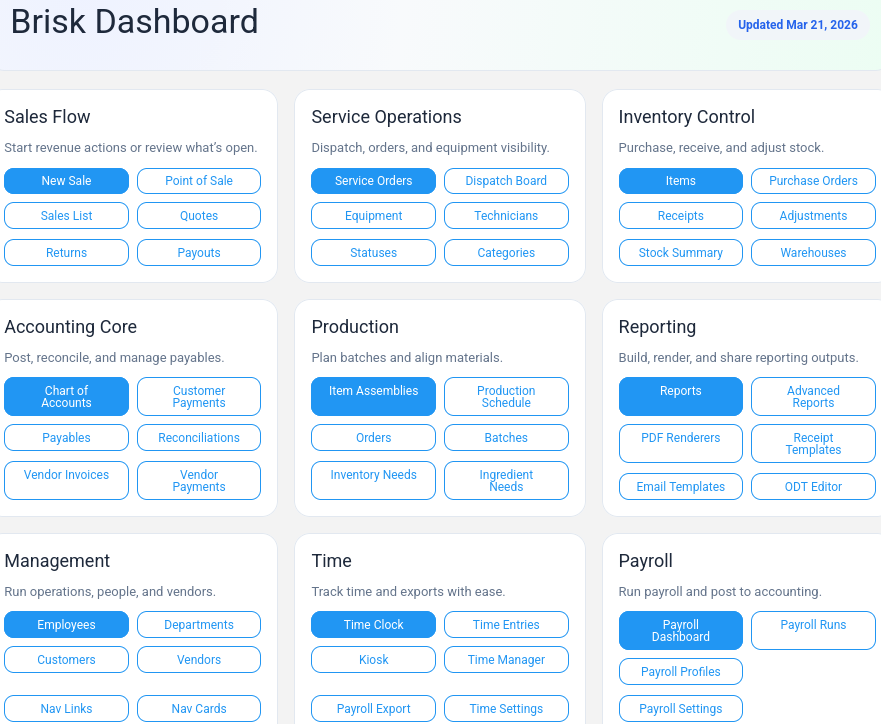
Storefront • Inventory sync • Accounting connection • Reporting • Flexible payment fit
One platform instead of multiple vendors.
Orders • Inventory • Accounting • Reporting • Operations
U.S.-based support • Real people • Built for long-term business relationships
Most ecommerce systems create more back-office work than they solve.
For many businesses, online selling starts simple. However, over time the store, inventory, accounting, reporting, and order workflow drift apart into separate systems that do not stay in sync.
That usually means more manual work, more reconciliation, more edge-case headaches, and less visibility into what is actually happening across the business.
Common ecommerce pain points
- Inventory drift between the storefront and the back office
- Orders that need manual handoffs or extra reconciliation
- Accounting disconnected from online sales activity
- Reporting that has to be pieced together manually
- Payment or platform restrictions that are not a good fit
Brisk gives you ecommerce as part of the business—not beside it.
Instead of treating online sales like a separate channel that needs constant translation back into operations, Brisk keeps the storefront connected to inventory, accounting, reporting, and the rest of the workflow from the start.
Inventory that stays tied to reality
Keep stock movement, costing, and order flow connected instead of relying on delayed syncs or manual corrections.
Accounting that sees the same business
Online sales activity stays connected to the financial side of the business instead of living in a separate world.
Reporting that is actually useful
See online activity in the context of the broader business instead of exporting data to piece answers together manually.
Order flow that reaches operations cleanly
Move from order activity to fulfillment and back-office follow-through with fewer manual handoffs.
One vendor instead of vendor sprawl
Reduce the overhead that comes from trying to manage the storefront, sync tools, and back-office systems separately.
More practical platform fit
Use ecommerce and payment workflows that better match the realities of your business.
From online order to reporting, the system stays in one lane.
1. Take the order
The storefront captures the sale without treating it like a disconnected event.
2. Keep stock aligned
Inventory stays tied to the same system that the rest of the business uses.
3. Keep accounting accurate
Order activity stays connected to financial visibility instead of needing to be translated later.
4. Report on the real business
See ecommerce in context instead of reconciling answers manually from multiple systems.
Get the upside of ecommerce without handing core operations off to disconnected tools.
More operational control
Keep the storefront connected to the business instead of building extra process around outside platforms.
Less manual cleanup
Reduce the reconciliation, sync checking, and extra handoffs that come from disconnected ecommerce stacks.
Better long-term fit
Use a system that can support growth, operational complexity, and business-specific realities more practically.
Ready for ecommerce software that fits the real business?
See how Brisk keeps online sales connected to inventory, accounting, reporting, and operations in one system.